
ANIMAL TALES & TAILS OF ANIMALS
FOREWORD
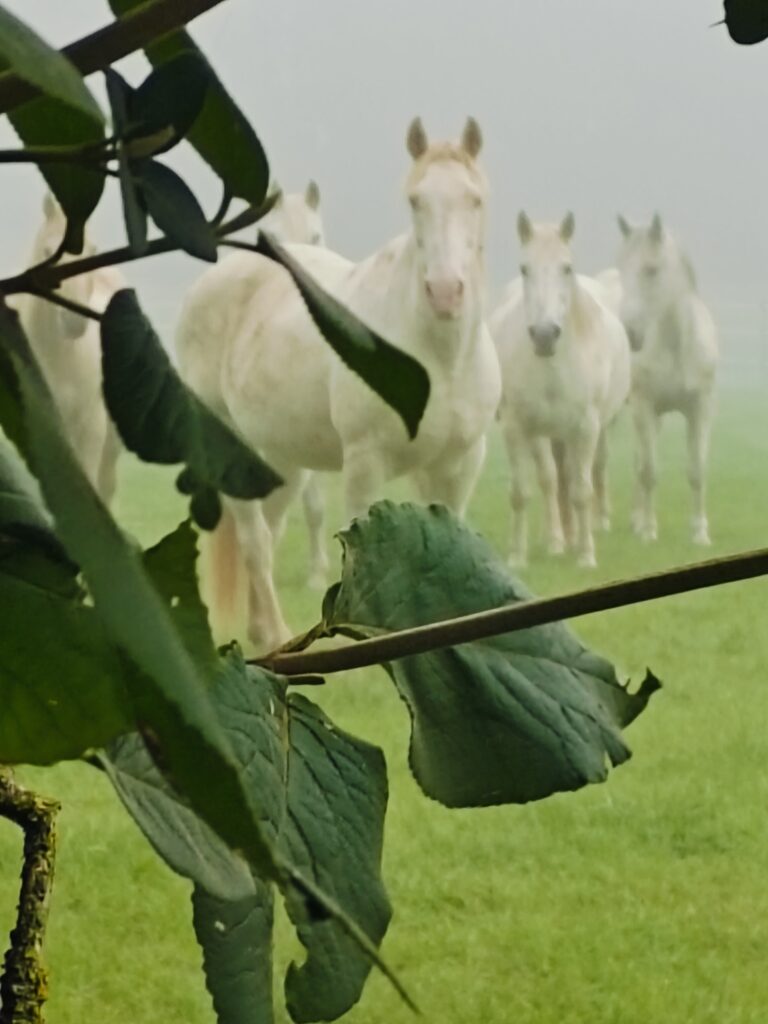
Before I write these stories down , I need to write down the experience, and the knowledge that came along with these type of horses. This knowledge came long after the period I was actually working them . However even if the situations were clear back then, the gain in understanding and seeing them in a broader perspective, time was needed. The closest word I can come up with in order to describe it; is Pressure. Not the kind of pressure mentally because at that time it was not directly present, since the horses that came along in this category came unspoiled, and not mistreated. And in a kind of way, it was the pressure as a structure or ‘structuring a way out of this’ for them. Structuring in order to give them a way to deal with it. But let’s get into the time frames; frame by frame so I can give you a kind of touch, so you can, maybe, recognise a common ground in your own experiences with your kind of horses that came along in your life. And in this way, I can prevent the words.: abnormal, stubborn, stupid, malformed. And one story stands out here.
Meet IDEFIX
This horse came along without a name, without any information at all. In fact there was a lot of information, but I was not told. So it took a while before I gave a name to this horse, but in that period IDEFIX seems suited. I would like to remind you that in the time of Asterix and obelix , their dog was called IDEFIX, and that is where I had the idea to call this horse IDEFIX. I needn’t not to know why, and in the beginning you don’t know why they do what they do. Just like the dog of Asterix and obelix, he does what he does.
Not far from the riding-school there was a farm ‘agriculture ‘ and I knew that there were 2 horses on that farm. Apparently it was a mother and her foal, and the foal around the age of four years, was the one that was coming in. So this horse never was raised in a group of other horses. It spent his four years with his mother and a farmer. It was a Monday when the riding school had his closing day and a lot of the horses had their day off on the prairies. It was also my favourite day because there was no crowd running around . The riding school was closed but I could come in, to work the young horses and frankly I loved these Mondays, because I had the whole riding- school to myself. There was one fact that I needed to overcome each time, namely the dog of the riding school. He was a mix of Jack Russell with street dog backgrounds named Ricky and he knew it was Monday and nobody was allowed in the riding school. Even though I entered the riding- school through the back door, he was waiting for me; my only way out of not getting his weekly ‘dog bite’ was to bribe him with a sugar cube. In fact, it took some sugar cubes before I could walk the stables free from his dominance. Now, I was not the only one. He was a well-known character and most of the people were feeding him sugar cubes with a small prayer that he would not get very old if you know what I mean. But the sugar suited him so fine because he had his a normal dog live and old age.
I had about an hour before I needed to get my kids from school and I thought well I could check out this new horse and maybe I just take him out to the paddock and place him back. As I mentioned this horse was bought and not one of their own breeding stock. Since I trained a lot of young horses it was that, from time to time, the father of Yvette bought a young horse and when they came in I was told I have another horse to train. So you need to know it was not of their own breeding stock. The horse stood in a new hanger deck where they keep the hay and straw. (See drawing.) He had a lot of space above their heads. The only thing was that you needed to go to a kind of small corridor to get in the hanger deck or go out.
Behind the wooden door you enter another section of the ridingschool where all the other horses had their stables.
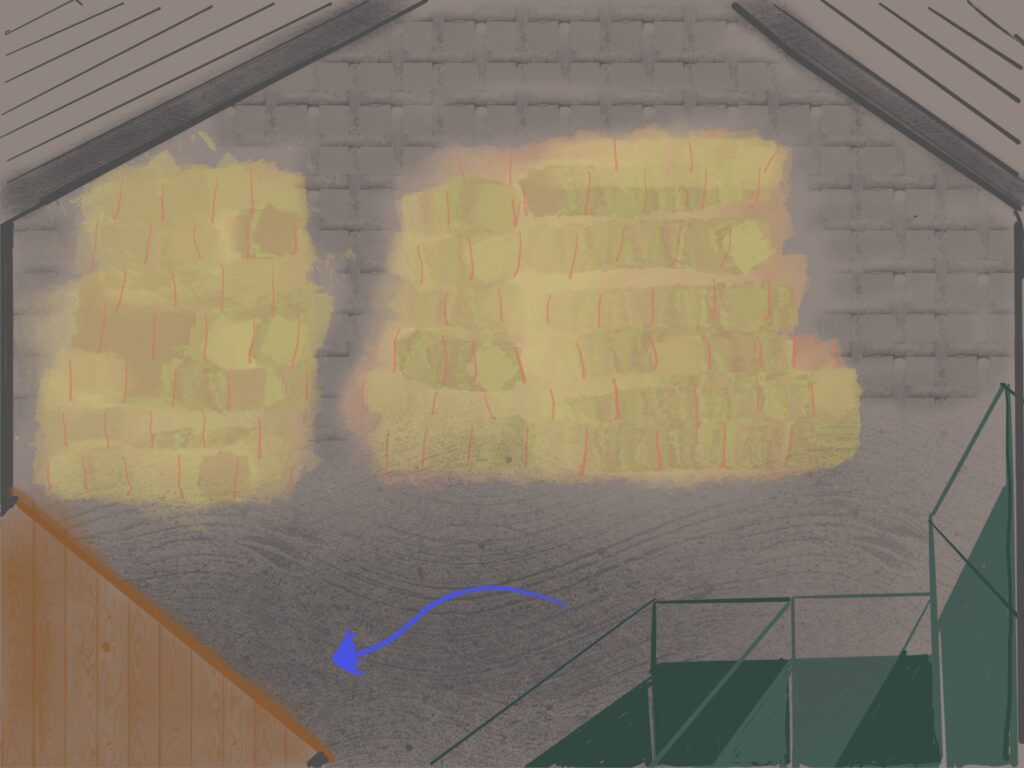
When I enter the hanger, this horse didn’t look up. There were other horses. The other horses raised their heads but not this horse, he stood there isolated. With no background information, I performed my own investigation and came quick to the conclusion that this horse needed to get out of that stable. He was in a condition that was not going to be solved by leaving him in there. Sadly my decision to do this quickly, so I could be on time to get my kids from school, only unveiled a greater and deeper problem. But the intention of a 20 minute getting him out and walk the stress away and bring him back inn, turned into more then a three hour session. It was one of these moments where you regret a lot of things. I never encountered a horse that was not moving at all and could not understand why and what the hell was going on about this horse story. With a few people we managed to get him to do a few steps and then nothing more. When we entered the small corridor, the black Smith’s son came to help and applied a lot of pressure to get that horse moving. After really really a lot of pressure and not getting this horse to move, he went back to his job and I was glad that the person backed off. But I was left with an unclear situation and regretted my decision in getting him out. I knew I was inn for a long period because I could not back off, certainly not now. So I called inn some help to get my kids from school and then I went to sit down next to the horse waiting to get some inspiration. Since we were standing in that small corridor, Idefix could hear and see other horses so I asked somebody to get a older horse and placed that horse before him. He reacted with interest towards that horse, but moving when asked, was not on the menu. I decided not to interfere between the two horses and ask a friend to get me a sandwich and a Coke, sit down next to the horse and started to eat my sandwich. That sore impression he had in his stable disappeared when he looked at that older horse. He wasn’t moving though. So each time little step-by-step, he followed that older horse and after an hour we had advanced 20 m further. I did notice a difference when we came outside the corridor and outside the riding school in open air. I think at this time two hours went by. Two hours for 50 m. Once outside, I just entered a indoor riding paddock and for me it was a major performance and I thought okay this is good enough now. I can go back to his stable. But it started again no movement even when we opened the big hanger doors . He had five meters to his right and 5 m to his left and like 3-4 metres above his head. It started again, no movement no nothing. I did recognise one pattern namely, he didn’t like to cross over a line, like a metal rod or having to step over something . Like in the stable there was a metal rod ( 5 cm wide) and when I layed some straw over it, it made a difference. The older horse was used as an example trying to get him over that metal rod. But it didn’t motivated him. I really wanted to end this session and decided to use a horse that was used to pull a wagon. Luckily for me there was someone present and she prepared her horse a Halflinger and tried to pull him out of that indoor riding paddock……. He decided to drop down on the ground and I saw he started to have some saliva coming out of his mouth. This was not going good and certainly not in a good way. I thanked the people and that halflinger, but I was not going through with this method. But there was a lucky moment. When he dropped himself down, his front legs were over the metal rod and when we got him to stand up, he was standing out with his front legs, out of the indoor riding paddock.. that helped. I kept on trying to get my head around this kind of behaviour. What was going on inside of him??????? I felt so sorry and helpless it’s not normal that a horse won’t move. Where is his fight and flight response???? Meanwhile almost 3 hour past and I was halfway. I managed to get him back to his stable and with an empty feeling and exhaustion on both sides I went home. So the next days I first work the other horses and when I passed or when I was going to have my meal, I went to the hanger deck opened the door of his stable, lay out some straw over the metal rods, sit down and just observe. I could understand that he reacted sore to my presence, but what I did find out, was, that when I observed him without he seeing me, the soreness was still present. In fact, he was always in a kind of soreness . He always turned his backhand towards me when entering the stable. This horse felt threatening in a lot of ways, or was it that he felt pressured and reacted on being constantly under pressure?. Just appearing in the hanger deck that state he took on was clear. But then I noticed something else. When he wasn’t able to see me and nobody else was in the hanger deck and all the other horses next to him were nibbling their hay or straw …..he would be standing sore. And then I saw it; for no reason at all I saw his soreness rising when looking at the wall and then kicking the wall. He had a kind of claustrophobia….could that be??? I started to enquiring how they transported this horse in the first place. And then the information came ; they tried to load this horse onto the truck and separating him from his mother after four years at the same time. It didn’t worked, in fact they told me they had to tie him to his mother and bring the mother to the riding school and took the mother back. Leaving him in the stable. Now I was getting somewhere. The day that followed I adjusted my training. I adjusted just in how to contact him, so more time was spend grooming him. Slowly, the time of getting him out of the stable directly to a prairie nearby helped. Gradually, I could move on, placing a saddle to even lunging, but one thing was sure; I could not trust him. When a horse is capable of dropping down or kicking, there is something deeper going on and I learned it the hard way. At a certain point he injured me. There is no logic that can explain this actions. This character is like on a lockdown not willing to open up. At a certain point I went out back to that farm, since, it was not so far away, I went looking at the conditions this horse was raised or more of a sense like he raised himself. That could be the only reason why he learned himself this kind of behaviour. Looking at the open hanger on that farm, the thought came to me that this horse never explored anything, just living like a cow and grazing & being close to his mother and he kind of never evolved further then just grazing. I adjusted my training again in making the moments that I had to come out of the box easier by directly going to the nearby Prairie and stand there. And it worked and directly I made also a mistake. Since he wouldn’t move, I thought I could put the saddle on and tie up the girth. The moment I knew I could not trust a horse, I would take precautions. Like when you have to tie up the girth, so the saddle can stay fixed, I would position myself on the front shoulder take a stick with a hook so I could bring the girth closer. So when a horse would try to kick me from behind, I would be in a safe spot…… I was wrong. There is a saying that some horses can kick like a cow, and I learned it the hard way. He kicked me right in my stomach. I was sure about something that this horse was not going to run away from anything so I kept the saddle on, walked him back to his stable and took the saddle off and then I took care of myself. I realised that with Idefix, if I wanted to advance in the training, I needed to put him in situation with the focus on the ability to learn and getting out of a situation so that he could learn himself to do that. Back in that period I didn’t knew that they are all kinds of training in Horsemanship that can deal and help you with this. I did it in a natural way by giving this horse an opportunity to explore. We continue to training and he never kicked again, but I also never trusted him in that position again. The first time I did get on him was by sitting on top of another horse and then transfer myself onto him. Again the solution of going outside for the walks and continue trainings there in that manner, has always paid off. Looking back, I should’ve worked that horse more on the ground before riding him. After a while, I could ride him and with the help of some other companion horses we managed to trot and Gallup. I never fully could understand this horse and his condition or should I say I never fundamentally cleared up the why and how of his situation.
I did encounter other types that belongs in this category. There was a horse (thinker) a very nice approachable horse that would do no one harm. But when this horse was running free in the indoor riding paddock. It seems that he didn’t want to go on trot. He would walk and that was it. It was also a horse that was bought and brought inn. Since he was very kind, gentle horse there was no defence mechanism shown. So I came up with the idea of placing Cavelletti on the ground and place pieces of apples between the Cavalletti. Soon he stepped over the Cavalletti eating the apples and after a while it helped that horse to synchronise the trot. Once this horse was used ‘ with a gentle pressure’ to move to trot and let him go over the cavaletti’s and back to walk whenever he liked, bit by bit the moments of trot became longer and extended until he was okay with his synchrony. It looked almost like he discovered something he had, but never used or had to use. So my question here rises that keeping perhaps horses in a small contour prevents them from discovering their proper movements and abilities. Then there was another horse I must say also a cold blood. You must know that in the indoor paddock, there was a great mirror placed at the end of the long line and when riding this horse , once he noticed himself in the mirror, I really had a hard time in turning him before the mirror if I let him be, he would run against the mirror. And then there was another horse much much later in life, that had the same issues, namely when she stopped, it was hard to get a move again. And she also had a kind of resistance to movement.
EVENT HORIZON
To sum this up, I will add a discovery I made . Thanks to a kind of repetitive behaviour of horses and animals, I can state this observation. This happened in the time where I had my own farm for the kids school & horses.
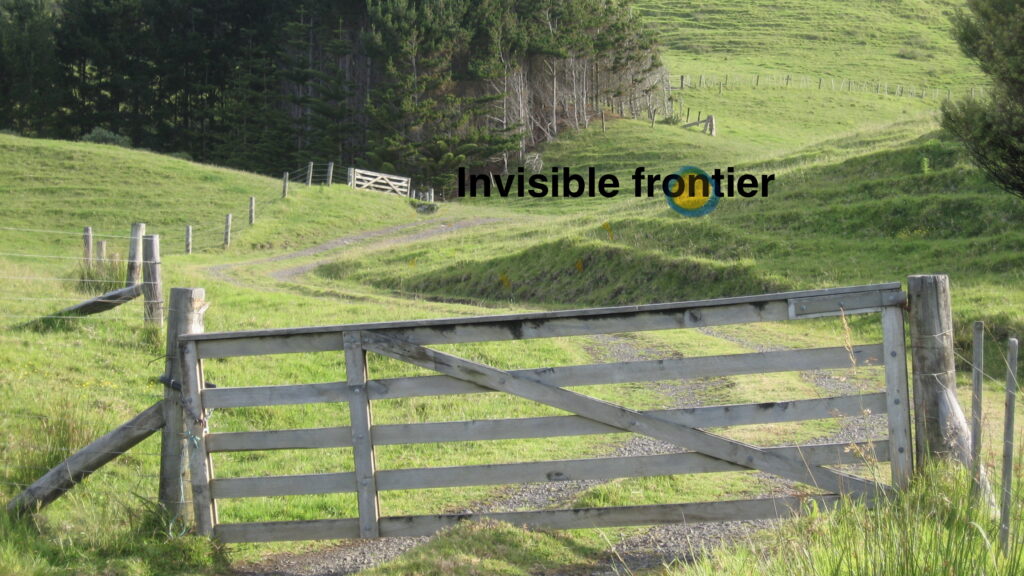
As I mentioned in the stories of chapter 4, that horses could suddenly stop or show a kind of unwillingness to start moving when asked. Let’s start in a position where you and your horse are trained in a regular manner and there’re no specific problems. So you saddle up on a nice Sunday morning, sun is shining and most of the people are still asleep and you decide to enjoy this ride. You are a regular horse rider so you know that sometimes the horse will hesitate. There are a lot of answers for the hesitation which includes. ( strange materials, loud vehicles, bicycles that are not being noticed, things coming from behind) these are the kinds that are visible and are not what I am talking about. It’s about an invisible frontier. And that is about it, about invisible for your mind, but not for the horse. All you need is to get in touch with a very gentle feel. There is a difference between feel and rationalize . But let an example clarify the difference. You’re walking your horse in a forest a forest well know for you and the horse so you take different kind of routes and if you are lucky to walk in a great forest or open spaces you’ve got a lot to discover. But they’re on your walks, the horse instead of proceeding ahead takes on the different turn and there’s a little difference between you two. A difference in intention . You have to work a bit to get your horse where you heading him to go. We all have been through that. That’s something we’re having in common. The same thing happens when you’re walking through a kind of village so you’re in the situation where there is only traffic, people and paved roads, but here again you also encounter that a certain time the horse wants to turn to another direction. Considering the fact that most of the horse riders know and are aware that a lot of horses do this because they know their way home. Also a fact or rather a saying is that if you let your reins free (so your horse is free to go where he wants) he will bring you home. You can test this out. The only thing is there’s a big difference doing this in a forest then in a village you’re passing through. That’s how we can justify the rationalisation of our minds. We know that if he take a paved road, you can end up further from home than you would like. This because you know you can read the signs and that the road is a connection to another village. You cannot get off that paved road. Now we can come to a mutual agreement that horses and all the animals think in terms of North, south, east and west. We humans, have build an organised -condition frame of geographic laid out places with a name. That’s our way. But here again for most of us we are aware that this is different for animals. Okay, so now I can come to the experience and observations I had. During my walks (with different horses ) sometimes I came across a path straight ahead with no spooky items nor any kind of hesitation, freaky situations, just a road undivided . On my left and on my right everything is just clear there are no other paths, they’re only trees & fields and a kind of horizon view. And there you have it. The horse starts to turn around and it’s not specifically a kind of stop but more of going around in little circles, but there is no getting further. And that is exactly the word to go “further “ the frontier seen as a distance, the horse arrived at the distance that he’s no more comfortable in his zone. Just have a look at the picture below.
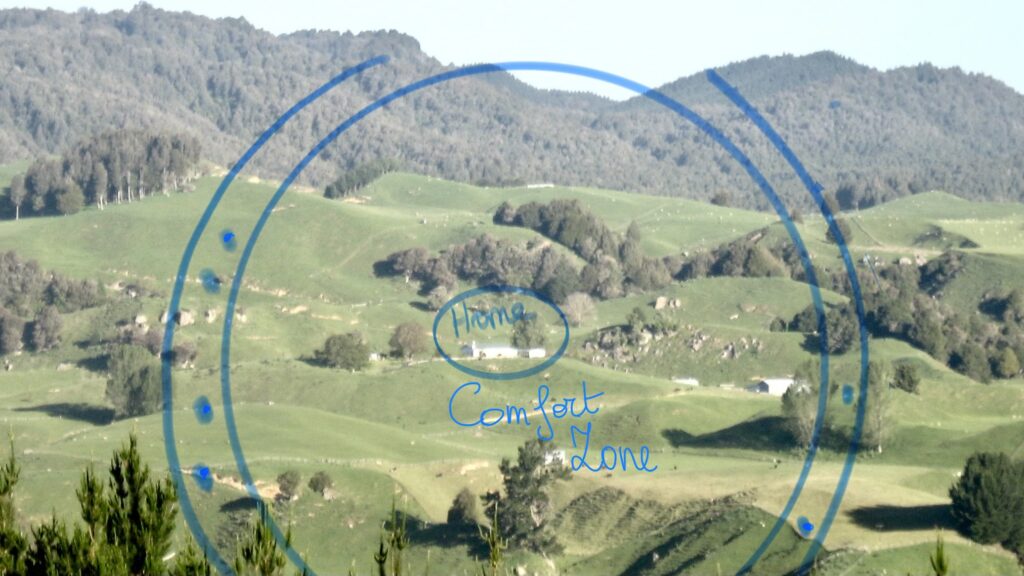
Between the two blue lines with the blue dots is the zone where a horse would want to get out off….. or back in the comfort zone. So here we have a zone that needs working, but if you have a rationalised mind you can create a lot of issues with your horse were the relationship could be damaged. For me this was the time, to get into stockmanship. One name, one person, one great mind in this; BUD WILLIAMS stockmanship school. (https://stockmanship.com ) The key here is that gentle fine feel that needs to be put into your handling the problem; namely teach your horse to move to another comfort zone. Maybe the kids from the period of the “Horenweg” could remember these kinds of lessons. Do you remember when you start riding, that in round pen the ponies would always come off track and be stuck in the middle of the round pen, where you needed to work to get them apart from each other? That period were all of you needed to lead off some steam and frustrations because these ponies always would not go where you want them to go and what was my answer….. lead your pony away from the others towards a point and once you arrive at that point, allow your pony to rest there. This was about leading them and creating another comfort zone. Where you can bring to the horse, I understand you, here is another comfort zone make it your own. And by the way that’s a good way to start separating horses that don’t want to be separated from the other. But more on that topic when we arrive more about stockmanship in another chapter. For me in my life that is where I decided to immigrate to the USA because I went to see Bud Williams and followed a course . That’s why I applied in the USA and where I obtained my green card. My whole life is intertwined through the horses.. because, it was because of the horses I wanted to immigrate and the reason why I did all my travels and yet again, it was a horse that made me come back to Belgium. But that is for another chapter.
As a closure to this chapter, I want to come back to stockmanship. I can refer to Steve Cote manual of Stockmanship . You can download or buy this Manual. It connects stockmanship with agriculture. There the connection to maintain the Earth crust and management to what kind of grass grows where , is obtained through how you move the cattle and you bringing the cattle to the grazing areas that needs to be grazed, through finding a comfort zone or creating one; . With the focus point in how to manage cattle and the horses you work within the larger open spaces, was based on Bud Williams’s techniques. When I went to New Zealand , I could exercise this on the farm with cows and sheep . A farm of around 500 hectares. A good experience, but I didn’t realised I ended up in an apparently Redneck-county. All I will say about this is ……you never stop learning. One learns some gains and learns some ‘don’t & how to get out’s’.
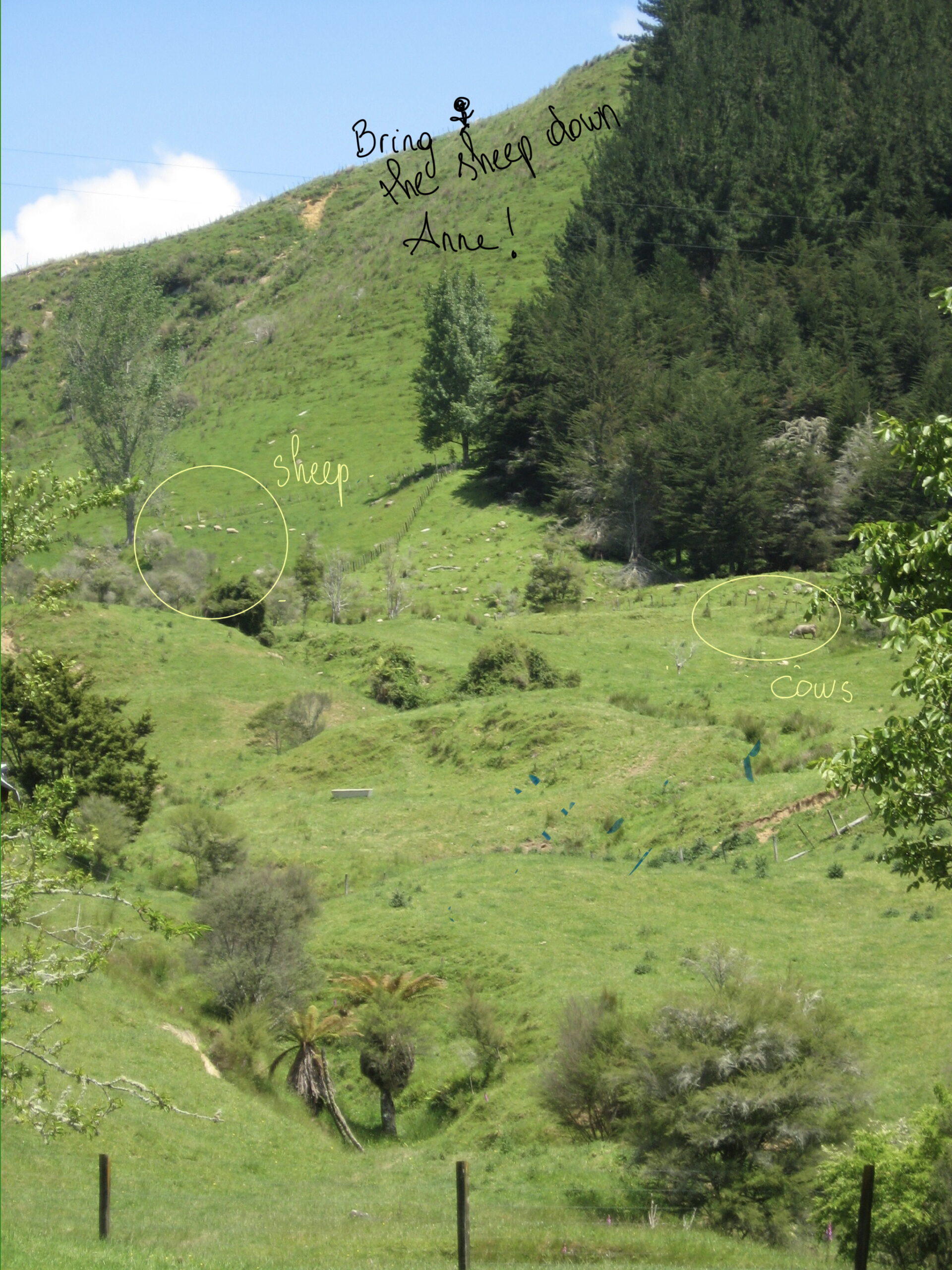
Bring the sheep down, Anne